Anglican-Roman Catholic Dialogue ~ IARCCUM.org
Online resource centre for Anglican-Roman Catholic relations
• 2026
• 2025
• 2024
• 2023
• 2022
• 2021
• 2020
• 2019
• 2018
• 2017
• 2016
• 2015
• 2014
• 2013
• 2012
• 2011
• 2010
• 2009
• 2008
• 2007
• 2006
• 2005
• 2004
• 2003
• 2002
• 2001
• 2000
• 1999
• 1998
• 1997
• 1996
• 1967
• 1966
 We invite you to visit our Bluesky feed, a new social media platform that replaces Twitter/X. Bluesky has reintroduced content moderation and eliminated advertizing. Follow us now on Bluesky.
Belgian bishop plans to ordain married men to fulfil Synod vision (21 Mar 2026)
A Call to Reconciliation: A Joint Document from ARCUSA (26 Feb 2026)
A letter to Bishops around the Anglican Communion (17 Feb 2026)
A paradigm shift for English Catholicism (11 Feb 2026)
Leicester capital of ecumenism for two-day meeting between Anglicans and Catholics
14 January 2019 • Persistent link: iarccum.org/?p=2999
Fifty bishops – 25 Anglicans and 25 Catholics – will convene in the British city next January 16-17. Rev Worthen told SIR: “Spirituality, theology and coexistence will be the ingredients of the meeting” that with a tight agenda: liturgy and debates with the spotlight on the Declaration “Walking Together On The Way”
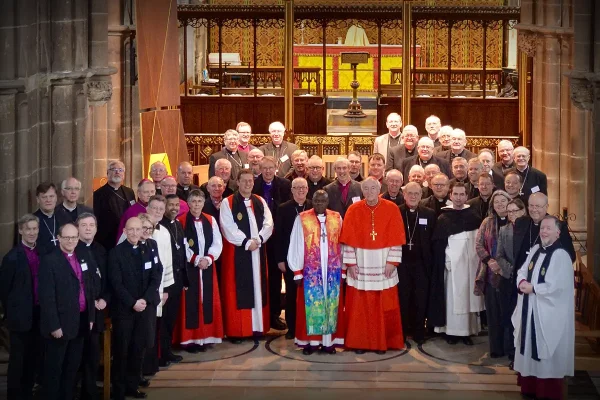
Next January 16 and 17 fifty bishops, half of them Catholic and half of them Anglican, will convene in Leicester, central England, a city with an important tradition of interreligious dialogue, for a two-day ecumenical meeting. These meetings take place every two or three years, providing participants with the opportunity to create precious relations based on mutual esteem, friendship and cooperation. “Spirituality, theology and coexistence are the ingredients of the Leicester meeting”, said Rev Jeremy Worthen, Secretary for Ecumenical Relations at the Council for Christian Unity, a body of the Church of England in charge of fostering relations between Christian churches. “The Church of England is in charge of organizing this year’s two-day event that will take place behind closed doors. In addition to the bishops, the meeting will be attended also by press officers and administrative staff.”
Dialogue, further progress. The meetings first started to be held after the release of the document “Growing together in unity and mission”, whose text was developed by the International Anglican – Roman Catholic Commission for Unity and Mission (IARCCUM). The document called for Anglican – Roman Catholic bishops’ “dialogues with a view to creating a context in which trust and friendship develop in the mutual love of Christ.”
The text was released in 2006, five years after the establishment of IARCCUM, tasked with implementing the theological work of the ARCIC Commission, set up in the mid-1970s after the first official meeting between a Pope (Paul VI) and an Anglican Archbishop (Michael Ramsey). Several documents ensued, centred on a set of different themes – the Eucharist, ordained ministry, the figure of the Holy Virgin Mary. While the dialogue intensified and the relations between the two Churches grew increasingly fraternal also at local level, new obstacles came up, such as women priests and same-sex marriage. “Indeed, the issues that divide us are complex ones”, said Reverend Worthen, “and the basic problem, that drags on since the time of the Henry VIII’s Reformation, that marked the rift between the Anglican and Roman Catholic Church, regards the question of authority.”
The program.
Anglican and Catholic bishops will pray together in Leicester. “We will start on Wednesday 16th, upon their arrival, with a religious gathering led by Anglicans, in the evening participants will convene in Leicester’s Cathedral for the Evensong, the traditional evening prayer”, Worthen explained. “The next day, Thursday 17th, Catholic bishops will co-celebrate Holy Mass in the church of the Dominican Monastery of the Holy Cross, in the city centre, that Anglican bishops are free to attend if they wish. The final prayer, at noon, will be officiated by the Church of England at the Conference centre adjacent the Cathedral, that is also the venue of the meeting.”
Being together.
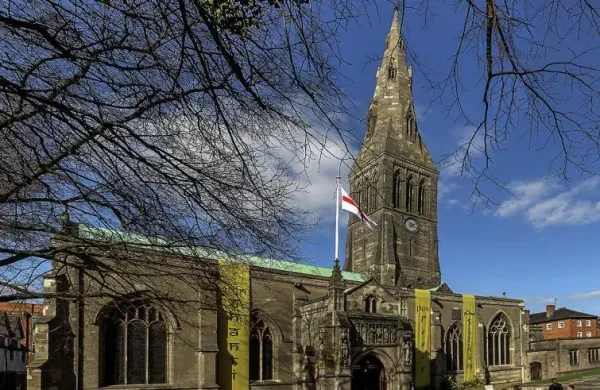
The city of Leicester, that captured world attention after the discovery of Richard III’s skeleton, was chosen for its location in the heart of England, thus within easy reach from the various dioceses in the Country. “When the King’s remains were first discovered and exhumed, a dialogue was initiated on where they should be buried and according to which religious rite. These are precisely the kind of questions that foster ecumenical dialogue”, Rev Worthen pointed out. “These meetings are a valuable opportunity for the bishops to meet, reflect and share time together.”
Theology and receptive Ecumenism.
The focus of the meeting is the Declaration of third ARCIC Commission titled “Walking Together On The Way. Learning to be a Church – Local, Regional, Universal“, that employs the method of Receptive Ecumenism, namely, to discern what is underdeveloped or overlooked in one’s religious tradition and examine its development in the respective traditions in order to learn from each other. “It’s a successful approach adopted across the globe. It enables us to acknowledge and reflect on our limitations. Such an example could be the fact that Catholics are more active at the level of global communion while the Anglican Church is more efficient at local level”, concluded Revered Worthen.