Anglican-Roman Catholic Dialogue ~ IARCCUM.org
Online resource centre for Anglican-Roman Catholic relations
• 2026
• 2025
• 2024
• 2023
• 2022
• 2021
• 2020
• 2019
• 2018
• 2017
• 2016
• 2015
• 2014
• 2013
• 2012
• 2011
• 2010
• 2009
• 2008
• 2007
• 2006
• 2005
• 2004
• 2003
• 2002
• 2001
• 2000
• 1999
• 1998
• 1997
• 1996
• 1967
• 1966
 We invite you to visit our Bluesky feed, a new social media platform that replaces Twitter/X. Bluesky has reintroduced content moderation and eliminated advertizing. Follow us now on Bluesky.
A Call to Reconciliation: A Joint Document from ARCUSA (26 Feb 2026)
A paradigm shift for English Catholicism (11 Feb 2026)
Italy’s Christian churches sign first ecumenical pact (5 Feb 2026)
Sarah Mullally confirmed as 106th archbishop of Canterbury (28 Jan 2026)
My Journey to Full Communion with the See of Peter (14 Jan 2026)
News & Opinion
• 2026
• 2025
• 2024
• 2023
• 2022
• 2021
• 2020
• 2019
• 2018
• 2017
• 2016
• 2015
• 2014
• 2013
• 2012
• 2011
• 2010
• 2009
• 2008
• 2007
• 2006
• 2005
• 2004
• 2003
• 2002
• 2001
• 2000
• 1999
• 1998
• 1997
• 1996
• 1967
• 1966
December ~ 2025 ~ Anglican-Roman Catholic news & opinion
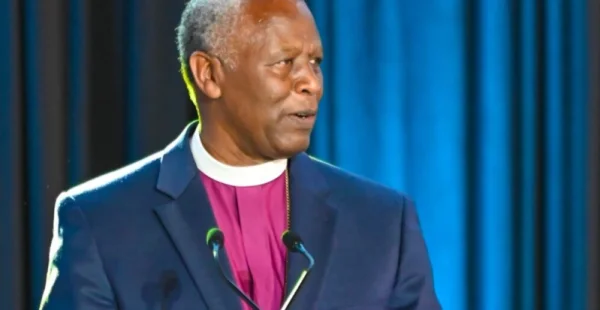
GAFCON, a conservative Anglican movement that claims to represent the majority of Anglicans worldwide, particularly in the Global South, is moving toward a formal reordering of global Anglican leadership following its October renunciation of the Archbishop of Canterbury’s authority.
A report presenting the results of the Commission’s work has been released. It rules out admitting women to the diaconate understood as a degree of the sacrament of Holy Orders, but says that it is not currently possible “to formulate a definitive judgment, as in the case of priestly ordination.”
“The status quaestionis of historical research and theological investigation, as well as their mutual implications, rules out the possibility of moving in the direction of admitting women to the diaconate understood as a degree of the sacrament of Holy Orders. In light of Sacred Scripture, Tradition, and the Church’s Magisterium, this assessment is strongly maintained, although it does not at present allow for a definitive judgment to be formulated, as is the case with priestly ordination.”
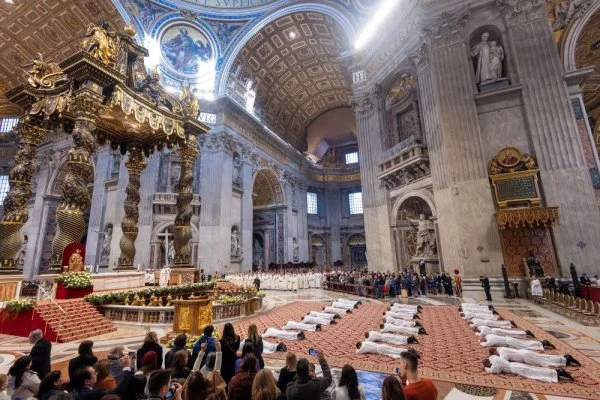
A Vatican commission studying the possibility of female deacons reported that the current state of historical and theological research “excludes the possibility of proceeding” toward admitting women to the diaconate, a conclusion that slows momentum on one of the church’s most debated questions while stopping short of a definitive no.
In a letter sharing the results of its work with Pope Leo XIV and released by the Vatican Dec. 4, the commission reported a 7-1 vote in favour of a statement concluding that the church cannot currently move toward admitting women to the third degree of holy orders, the diaconate.
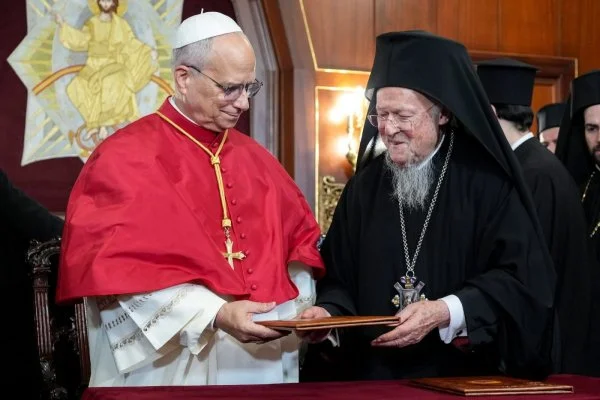
Pope Leo XIV and Ecumenical Patriarch Bartholomew of Constantinople called on Christians of the East and West to finally agree on a common date for Easter.
During a meeting at the patriarchal palace on 29 November, the two leaders — who met to celebrate the 1,700th anniversary of the Council of Nicaea — said the anniversary should inspire “new and courageous steps on the path toward unity,” including finding that common date.