Anglican-Roman Catholic Dialogue ~ IARCCUM.org
Online resource centre for Anglican-Roman Catholic relations
• 2026
• 2025
• 2024
• 2023
• 2022
• 2021
• 2020
• 2019
• 2018
• 2017
• 2016
• 2015
• 2014
• 2013
• 2012
• 2011
• 2010
• 2009
• 2008
• 2007
• 2006
• 2005
• 2004
• 2003
• 2002
• 2001
• 2000
• 1999
• 1998
• 1997
• 1996
• 1967
• 1966
 We invite you to visit our Bluesky feed, a new social media platform that replaces Twitter/X. Bluesky has reintroduced content moderation and eliminated advertizing. Follow us now on Bluesky.
A Call to Reconciliation: A Joint Document from ARCUSA (26 Feb 2026)
A paradigm shift for English Catholicism (11 Feb 2026)
Italy’s Christian churches sign first ecumenical pact (5 Feb 2026)
Sarah Mullally confirmed as 106th archbishop of Canterbury (28 Jan 2026)
My Journey to Full Communion with the See of Peter (14 Jan 2026)
Do not call Mary ‘Co-redemptrix’, says Vatican
4 November 2025 • Persistent link: iarccum.org/?p=5444
‘This title risks obscuring Christ’s unique salvific mediation and can therefore create confusion and an imbalance in the harmony of the truths of the Christian faith.’
It is “not appropriate” to refer to the Virgin Mary as “Co-redemptrix” because it obscures Christ’s exclusive role in the work of redemption, according to a new Vatican document.
“This title risks obscuring Christ’s unique salvific mediation and can therefore create confusion and an imbalance in the harmony of the truths of the Christian faith,” the document says. “When an expression requires many, repeated explanations to prevent it from straying from a correct meaning, it does not serve the faith of the People of God and becomes unhelpful.”
It includes an assessment of the title “Mediatrix”, advising “special prudence” in its use and emphasising the need “to specify the range of its value as well as its limits” to avoid obscuring the precise nature of Mary’s mediation.
“Christ’s mediation, which in some respects can be ‘inclusive’ or shared, is in other respects exclusive and incommunicable.”
The Dicastery for the Doctrine of the Faith (DDF) published Mater populi fidelis (“The Mother of the Faithful People”), a doctrinal note “On Some Marian Titles Regarding Mary’s Cooperation in the Work of Salvation”, on 4 November. Pope Leo approved the text on 7 October, the Feast of Our Lady of the Rosary.
The document is intended to “clarify in what sense certain titles and expressions referring to Mary are acceptable or not” and “deepen the proper foundations of Marian devotion by specifying Mary’s place in her relationship with believers in light of the Mystery of Christ as the sole Mediator and Redeemer”.
This aim “entails a profound fidelity to Catholic identity while also requiring a particular ecumenical effort” to “foster a proper contemplation of the harmony of the Christian message as a whole”.
“The piety of the faithful People of God – who find in Mary refuge, strength, tenderness, and hope – is not contemplated here to correct it but, above all, to appreciate, admire, and encourage it,” says a prefatory note by the DDF prefect Cardinal Víctor Manuel Fernández. “For this piety is a mystagogical and symbolic expression of an evangelical attitude of trust in the Lord, which the Holy Spirit freely stirs up in believers.”
He warns that “some Marian reflection groups, publications, new devotions, and even requests for Marian dogmas that do not share the same characteristics as popular devotion” express “themselves intensely through social media, often sowing confusion among ordinary members of the faithful”.
During the presentation of the document on Tuesday at the Jesuit Curia in Rome, a member of the public repeatedly interrupted Cardinal Fernández’s address even as he acknowledged that “this document will not please some people”.
In its introduction, the document notes that some alleged apparitions give rise to particular titles for Our Lady, and “these titles – some of which already appear in the writings of the Church Fathers – are not always employed precisely, and their meanings are sometimes altered or misinterpreted.
“Beyond terminological issues, some titles pose significant difficulties regarding their content because they can often lead to a mistaken understanding of Mary’s role, which carries serious repercussions at the Christological, ecclesiological and anthropological levels.”
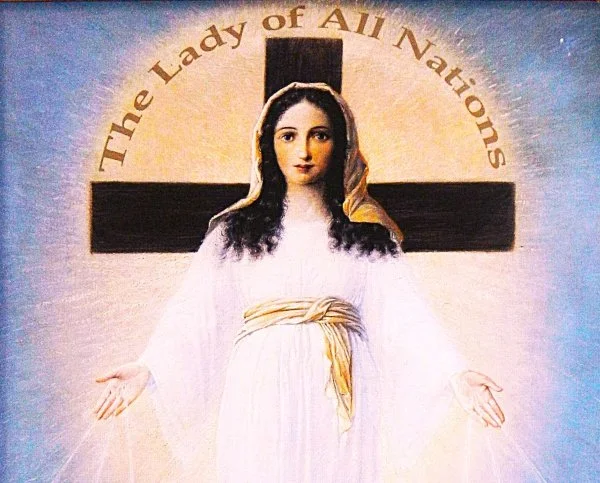
In June 2024, the DDF reaffirmed a 1974 ruling the apparitions of “The Lady of All Nations” in Amsterdam between 1945 and 1959 were not supernatural in origin. These are closely connected to a proposed “fifth Marian dogma” defining Mary as “Co-redemptrix, Mediatrix and Advocate”.
John Paul II referred to Mary as “Co-redemptrix” on at least seven occasions, relating the title to the value of suffering offered together with the sufferings of Christ to which she was especially united at the cross, but did not propose a formal definition.
The then-Cardinal Joseph Ratzinger expressed concerns about the title, warning that it “departs to too great an extent from the language of Scripture and of the Fathers and therefore gives rise to misunderstandings”.
The document instead promotes the idea of Mary as “Mother of all believers” through the popular piety “that takes different forms in different peoples”.
“The faithful People of God do not distance themselves from Christ or the Gospel when they draw near to Mary,” it says. “The suffering people recognise Mary as walking side by side with them, and so they seek out their Mother to implore her help.”