Anglican-Roman Catholic Dialogue ~ IARCCUM.org
Online resource centre for Anglican-Roman Catholic relations
• 2026
• 2025
• 2024
• 2023
• 2022
• 2021
• 2020
• 2019
• 2018
• 2017
• 2016
• 2015
• 2014
• 2013
• 2012
• 2011
• 2010
• 2009
• 2008
• 2007
• 2006
• 2005
• 2004
• 2003
• 2002
• 2001
• 2000
• 1999
• 1998
• 1997
• 1996
• 1967
• 1966
 We invite you to visit our Bluesky feed, a new social media platform that replaces Twitter/X. Bluesky has reintroduced content moderation and eliminated advertizing. Follow us now on Bluesky.
Belgian bishop plans to ordain married men to fulfil Synod vision (21 Mar 2026)
A Call to Reconciliation: A Joint Document from ARCUSA (26 Feb 2026)
A paradigm shift for English Catholicism (11 Feb 2026)
Italy’s Christian churches sign first ecumenical pact (5 Feb 2026)
Sarah Mullally confirmed as 106th archbishop of Canterbury (28 Jan 2026)
GAFCON says its members will leave Anglican Communion to form rival network
17 October 2025 • Persistent link: iarccum.org/?p=5402
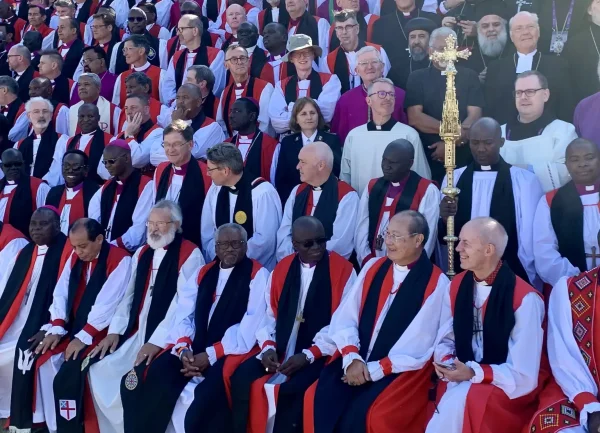
The conservative Anglican network GAFCON, a mix of leaders from Anglican provinces and breakaway groups, released a statement Oct. 16 saying it would disengage from the Anglican Communion’s existing deliberative bodies and create a rival to the Anglican Communion with an unspecified number of provinces.
The message, titled “The Future Has Arrived” and posted to GAFCON’s website, was signed only by Archbishop Laurent Mbanda of Rwanda, as chair of the network’s primates council, though Mbanda said he was issuing the statement after a meeting with other GAFCON primates about their path forward.
In it, Mbanda said the GAFCON primates have rejected the authority of the archbishop of Canterbury, the Anglican Consultative Council, the Lambeth Conference of Anglican bishops and the Primates’ Meeting, the four so-called “Instruments of Communion” by which the 42 autonomous provinces of the Anglican Communion maintain their interdependence. It also says the breakaway provinces “shall not make any monetary contribution to the ACC, nor receive any monetary contribution from the ACC or its networks.”
Mbanda and his Anglican Church of Rwanda have boycotted Instruments of Communion meetings for years, as have leaders of the Anglican provinces in Nigeria and Uganda. Until now, conservative primates in other provinces, though affiliated with GAFCON, have continued to engage with their peers across the Anglican Communion at those meetings.
It was not clear from Mbanda’s statement how many of his fellow primates now planned to join him in forming what he said would be called the “Global Anglican Communion.” Of the members of GAFCON’s primates’ council listed on its website, nine are leaders of provinces that are recognized as part of the Anglican Communion: Alexandria (Egypt), Chile, Congo, Kenya, Myanmar, Nigeria, Rwanda, South Sudan and Uganda. The statement did not specify which of those members attended the meeting before the statement was released.
Mbanda also did not specify the reason for timing this decision now, though his statement was issued two weeks after the Church of England announced that London Bishop Sarah Mullally would become the first female archbishop of Canterbury, a position that represents a “focus of unity” for the 85-million-member Anglican Communion in recognition of the 42 provinces’ roots in the Church of England.
Some of the communion’s more conservative provinces do not allow women to become bishops, and several of those provinces’ leaders released statements this month grieving the choice of Mullally, who is scheduled to take office as archbishop of Canterbury in January.
GAFCON’s latest statement, which rejects continued participation in the Anglican Consultative Council, also was issued a day after the ACC Standing Committee held its annual meeting Oct. 13-15 in Jordan. The ACC is structured to welcome representatives from all 42 provinces, a mix of bishops, other clergy and lay leaders.
The full ACC is scheduled to discuss possible changes to the Anglican Communion’s leadership structure, including the role of the archbishop of Canterbury, when it meets in June and July 2026 in Belfast, Northern Ireland. It isn’t clear yet how the GAFCON statement will affect discussions of what are known as the Nairobi-Cairo Proposals.
In an Oct. 17 written statement to Episcopal News Service, the Rt. Rev. Anthony Poggo, secretary general of the Anglican Communion and a bishop from South Sudan, said the Anglican Communion “is ordered by historic bonds, voluntary association” and that any changes “should be made through existing structures.” That is why, he said, the work of the Nairobi-Cairo Proposals is important.
GAFCON was formed in 2008 in opposition to the increasingly welcoming policies toward LGBTQ+ Christians that were embraced by some Anglican provinces, including The Episcopal Church. Mbanda’s statement this week alludes to those disagreements over human sexuality, accusing more progressive Anglicans of “the abandonment of the Scriptures” and saying global Anglican leadership had “failed to uphold the doctrine and discipline of the Anglican Communion.”
Episcopal Church Presiding Bishop Sean Rowe released a statement to ENS for this story, affirming that The Episcopal Church places “great value on our continuing relationships in the Anglican Communion and on the historic role of the archbishop of Canterbury as first among equals.”
“We celebrate Bishop Sarah Mullally’s elevation to that seat and rejoice that, as the first woman to hold that role, she will bring our communion closer to the fullness of the image of God and bear witness to the breadth of God’s gifts in the service of God’s mission to the world,” Rowe said. “It is always a cause of sorrow when siblings in Christ choose to walk apart, and we grieve that some GAFCON primates have chosen to remove themselves from the Anglican Communion. We pray for their participation in God’s mission in their contexts.”
The Nairobi-Cairo Proposals were developed by the Inter-Anglican Standing Commission on Unity, Faith and Order upon request of the ACC at its meeting in February 2023, which was attended by leaders from all 42 Anglican provinces except Nigeria, Uganda and Rwanda. The draft proposals were released in December 2024, and Poggo emphasized that all Anglican Communion primates, members of the ACC and others from Global South Fellowship of Anglicans and GAFCON have been invited to engage with the proposals in advance of next year’s ACC meeting.
“The Anglican Communion Office recognizes that in a diverse, global communion, there is a wide range of theological and doctrinal perspectives. There are also deeply held differences, disagreements, and divisions, which strain and wound the Communion,” said Poggo, who also shared a pastoral letter on Oct. 17 with Anglican provinces. “The Nairobi-Cairo Proposals face these divisions directly, not to resolve them, but to encourage all Anglicans to ‘make room for one another.’
“Jesus prayed that ‘they may all be one’ (John 17.11). To persist in – imperfect, impaired – communion is to commit to work at this task together, and not apart.”
David Paulsen is a senior reporter and editor for Episcopal News Service based in Wisconsin. He can be reached at dpaulsen@episcopalchurch.org.