Anglican-Roman Catholic Dialogue ~ IARCCUM.org
Online resource centre for Anglican-Roman Catholic relations
• 2025
• 2024
• 2023
• 2022
• 2021
• 2020
• 2019
• 2018
• 2017
• 2016
• 2015
• 2014
• 2013
• 2012
• 2011
• 2010
• 2009
• 2008
• 2007
• 2006
• 2005
• 2004
• 2003
• 2002
• 2001
• 2000
• 1999
• 1998
• 1997
• 1996
• 1967
• 1966
 We invite you to visit our Bluesky feed, a new social media platform that replaces Twitter/X. Bluesky has reintroduced content moderation and eliminated advertizing. Follow us now on Bluesky.
Little evidence so far that Anglican leaders plan to join GAFCON in leaving Anglican Communion (23 Oct 2025)
Fraternity and hope strengthen relations between Catholics and Anglicans (23 Oct 2025)
Pope Leo and King Charles make history with first-ever joint prayer service in Sistine Chapel (23 Oct 2025)
King Charles and the Catholic ‘hand of history’ (19 Oct 2025)
GAFCON says its members will leave Anglican Communion to form rival network (17 Oct 2025)
News & Opinion
• 2025
• 2024
• 2023
• 2022
• 2021
• 2020
• 2019
• 2018
• 2017
• 2016
• 2015
• 2014
• 2013
• 2012
• 2011
• 2010
• 2009
• 2008
• 2007
• 2006
• 2005
• 2004
• 2003
• 2002
• 2001
• 2000
• 1999
• 1998
• 1997
• 1996
• 1967
• 1966
ARCIC from the Anglican-Roman Catholic dialogues
The Pontifical Council for Promoting Christian Unity and the Anglican Communion Office announced in a communique today that the most recent report of the Anglican-Roman Catholic International Commission (ARCIC), entitled “Mary: Grace and Hope in Christ,” will be presented on May 16, 2005 in Seattle, U.S.A., where the Commission last met and completed its work on the document. Cardinal Walter Kasper is the president of the pontifical council.
Honest analysis can bolster bonds of communion
In years past, since the close of the Second Vatican Council, relations between the Catholic Church and the Anglican Communion have focussed on theological dialogue and on seeking appropriate means to engage together in prayer, witness and mission.
During the past year the focus has shifted, as the Anglican Communion is in the midst of a major discernment process, attempting to address internal tensions which threaten to divide it.
The decisions which Anglicans will make over the coming months will not only set a course for the Anglican Communion, but will also significantly shape Anglican–Catholic relations.
The Director of Ecumenical Affairs at the Anglican Communion Office (the Revd Canon Gregory K Cameron) last month reported to the Joint Standing Committee of the Primates and Anglican Consultative Council (ACC) that the current Anglican–Roman Catholic dialogue had reached a significant milestone.
In a report to the Joint Standing Committee, which was held in Canterbury in March, Canon Gregory Cameron confirmed that the Anglican – Roman Catholic International Commission (ARCIC) had completed its work on a document “Mary: Grace and Hope in Christ” setting out an agreed framework for the theological and devotional understanding of Mary in the Christian faith.
The Anglican-Roman Catholic International Commission (ARCIC) has agreed on a methodology based on Scripture and theological reflection in its attempt to fix a strategy to go behind what it describes as “entrenched positions” on the Virgin Mary.
The Commission has just concluded its week–long meeting in Seattle under the co–chairmanship of Australian Anglican Primate and Perth Archbishop Peter Carnley.
It completed work on the text of the Seattle Statement, Mary: Grace and Hope in Christ, which it is now submitting to the Pontifical Council for Promoting Christian Unity and to the Archbishop of Canterbury, together with the Anglican Consultative Council.
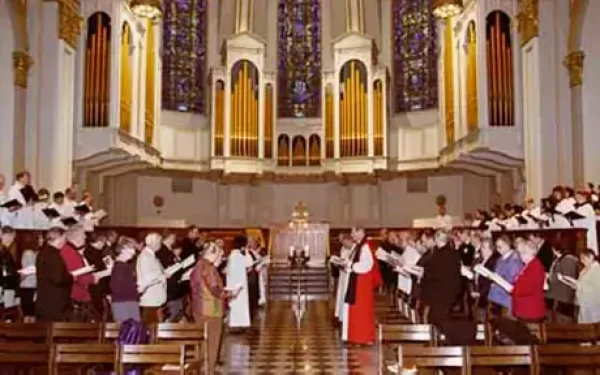
The Anglican-Roman Catholic International Commission (ARCIC) met from 28 January – 3 February at the Palisades Retreat Centre, Seattle, under the co–chairmanship of the Most Rev Alexander J Brunett, Archbishop of Seattle, and the Most Rev Peter Carnley, Archbishop of Perth and Primate of the Anglican Church of Australia.
The Commission completed work on the text of the Seattle Statement, “Mary: Grace and Hope in Christ“, which it is now submitting to the Pontifical Council for Promoting Christian Unity and to the Archbishop of Canterbury together with the Anglican Consultative Council.
Dialogue between the Catholic Church and the Anglican Communion has received its first setback since the American Anglicans consecrated an actively gay bishop last month. The Vatican said on Tuesday it was suspending a meeting in the United States scheduled for February which had intended to work on a common statement of faith between Catholics and Anglicans. The meeting “would have to be put on hold” because of “ecclesiological concerns” raised by “recent developments within the Anglican Communion,” according to a statement by the Vatican‘s Council for the Promotion of Christian Unity, whose president is Cardinal Walter Kasper.
Advent is for Christians a season of hope and anticipation that precedes Christmas. But this year it is a time of splintered hopes for Seattle‘s Roman Catholic Archbishop Alex Brunett.
Brunett has made ecumenical dialogue the touchstone of his 45 years as a Catholic clergyman.
He once was host for Jewish rabbis at a service at the Shrine of the Little Flower in Royal Oak, Mich., a church that was base for the 1930s anti–Semitic “radio priest” Father Charles Coughlin.
On Tuesday, November 25, 2003, Cardinal Walter Kasper, President of the Pontifical Council for the Promotion of Christian Unity, met with the Reverend Canon John L. Peterson, Secretary General of the Anglican Consultative Council, at the offices of the Pontifical Council.
At the meeting the future of Anglican–Roman Catholic dialogue was discussed, especially in the light of recent developments within the life of the Anglican Communion.
As a result of the conversation, it was decided that the next plenary session of the International Anglican–Roman Catholic Commission for Unity and Mission (IARCCUM) and its work towards the publication and reception of a Common Statement of Faith would have to be put on hold in the light of ecclesiological concerns raised as a consequence of these events. At the same time, the Anglican Communion and the Catholic Church remain committed to continuing their dialogue, and agree that the work of the sub–committees of the Commission would proceed.
On Tuesday 25 November 2003, Cardinal Walter Kasper, President of the Pontifical Council for the Promotion of Christian Unity, met with the Reverend Canon John L. Peterson, Secretary General of the Anglican Consultative Council, at the offices of the Pontifical Council. At the meeting the future of Anglican Roman Catholic dialogue was discussed, especially in the light of recent developments within the life of the Anglican Communion.
One of the subtleties of Shakespeare’s As You Like It is the existence of layers of sexual ambiguity implied in its original performance: a boy–actor played the part of a young woman disguised as a young man who at one point is pretending to be a girl. I was put in mind of these layers of meaning when I read The Eucharist: sacrament of unity (ESU), the Church of England’s highly courteous and careful response to the British and Irish bishops’ 1998 teaching document on eucharistic doctrine and sharing entitled One Bread One Body (OBOB). There is of course one vitally important difference: whereas the play’s layers form the stages in a dialectic, i.e. an interactive process, of ambiguity, the theological document offers a dialectic of clarification, which provides a model of what is involved in ecumenical reception.
At a press briefing in Westminster Abbey, London, today, the co–chairmen of the Anglican Roman Catholic International Commission (ARCIC), the Rt Revd Mark Santer (Anglican) and the Rt Revd Cormac Murphy–O‘Connor (Roman Catholic), launched the document “The Gift of Authority“, the latest in study documents issued by 18 members of the Commission.
This new document is the third agreed statement from ARCIC to address the question of authority in the church – its nature, exercise and implications. The statement takes into account the recent work in both Churches concerned with the matter of authority – the Lambeth Conference 1998 resolutions of the topic, “The Virginia Report” (Anglican document sent to the Provinces), and the 1995 Encyclical Letter on Ecumenism, “Ut Unum Sint“.
I welcome the publication of the ARCIC‘s latest document, “The Gift of Authority“. I would like to express my thanks to the Co–Chairmen of the Commission, Bishop Cormac Murphy O‘Connor and Bishop Mark Santer, together with their colleagues, for all their hard work and dedication.
“The Gift of Authority” tackles the most controversial of theological issues separating Roman Catholics and Anglicans. It is noteworthy that in earlier stages in the life of ARCIC it was recognised that more work would be needed before the same level of agreement could be recorded on Authority as was achieved on the topics of the Eucharist and Ministry and Ordination.
The end of the road is nowhere near being in sight yet, but solid progress is being made: this was the impression given by the communiqué and press conference that followed last week‘s second meeting of the Anglican–Catholic joint preparatory commission, held at Huntercombe Manor, Taplow, Berks, from August 30th to September 3rd.
Indeed, the frequency of the commission‘s meetings seems to be increasing: while the first meeting was held seven and a half months ago at Gazzada in northern Italy, it is hoped to hold the third meeting towards the end of December, at the most only four months hence. Where it will be held is not yet certain: it has to be some where near a large international airport, but the likelihood of fog at that time of year rules out London airport, and therefore England.