Anglican-Roman Catholic Dialogue ~ IARCCUM.org
Online resource centre for Anglican-Roman Catholic relations
• 2026
• 2025
• 2024
• 2023
• 2022
• 2021
• 2020
• 2019
• 2018
• 2017
• 2016
• 2015
• 2014
• 2013
• 2012
• 2011
• 2010
• 2009
• 2008
• 2007
• 2006
• 2005
• 2004
• 2003
• 2002
• 2001
• 2000
• 1999
• 1998
• 1997
• 1996
• 1967
• 1966
 We invite you to visit our Bluesky feed, a new social media platform that replaces Twitter/X. Bluesky has reintroduced content moderation and eliminated advertizing. Follow us now on Bluesky.
Pope and Archbishop of Canterbury exchange letters on Archbishop Sarah’s Installation (26 Mar 2026)
Archbishop of Canterbury Sarah Mullally installed in service attended by Anglican Communion leaders (25 Mar 2026)
Belgian bishop plans to ordain married men to fulfil Synod vision (21 Mar 2026)
Gafcon to be led by new Global Anglican Council including clergy, laity, and bishops (6 Mar 2026)
IASCUFO shares learnings and supplement to The Nairobi-Cairo Proposals in preparation for ACC-19 (2 Mar 2026)
Catholic, Anglican, Lutheran bishops of Saskatchewan sign new covenant
2 April 2020 • Persistent link: iarccum.org/?p=5541
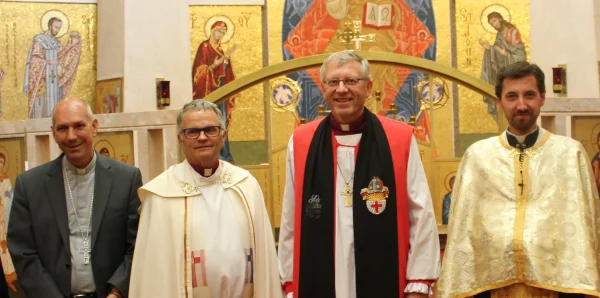
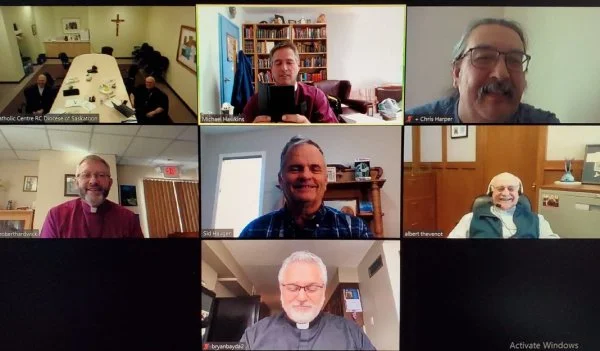
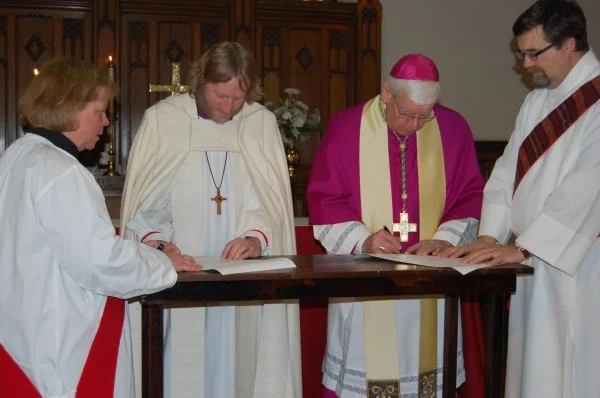
A new covenant among the leaders of the Lutheran, Anglican, Ukrainian and Roman Catholic churches in the province was announced April 2, 2020 by the bishops of Saskatchewan.
“It is our hope that the signing and release of this covenant will be a source of encouragement at this difficult moment in time, and a life-giving enrichment of our churches moving forward,” states a message from the bishops to their churches about the new covenant.
Because of COVID-19 restrictions, “The LAURC Covenant” (LAURC = Lutheran, Anglican, Ukrainian, Roman Catholic) was not signed in a face-to-face meeting, but was finalized in an electronic meeting. The new covenant bears the signatures of:
The expanded covenant grows out of a covenantal relationship that the Anglican Diocese of Qu’Appelle and the Roman Catholic Archdiocese of Regina entered into in 2011, the message notes.
“For many years, the Anglican, Lutheran, Ukrainian and Roman Catholic bishops have met, twice a year, to share concerns and build relations. Two years ago we began working on a draft of an expanded covenant that would include all of our churches in Saskatchewan, with the help of an expanded implementation committee with all of our churches represented,” wrote the bishops.
“The COVID-19 pandemic prevented an in-person meeting in mid-March, but we met through electronic means to finalize the covenant which we now rejoice in signing and making public. This is an historic event in the life of our churches. We hope and pray that this covenant brings as much joy to our people as it does to us as your bishops.”
The original covenant text was signed on behalf of the Anglican Diocese of Qu’Appelle and the Roman Catholic Archdiocese of Regina on Jan. 23, 2011 by Bishop Gregory Kerr-Wilson (now the Anglican Bishop of Calgary) and Archbishop Daniel Bohan, who died in 2016.
Ecumenical covenants have been an important catalyst for local ecumenical communities, explains Nicholas Jesson, Ecumenical Officer for the Archdiocese of Regina. “There are many covenants between congregations or parishes of various traditions. There are a number of examples of covenants between Anglican and Roman Catholic dioceses, and a few that include Lutheran synods. The acronyms ARC, LRC, and LARC are frequently used for these. The LAURC Covenant in Saskatchewan appears to be the first covenant including an Eastern Catholic eparchy.”
An ecumenical covenant is not intended to be an exclusive relationship, he adds. “It is hoped that our churches will continue to foster close relations with all faith communities in their neighbourhoods, and that where appropriate these will blossom into a renewed covenantal relationship. Our covenant is intended to be a witness to the unity we already share in Christ and to our commitment to work together to give this visible expression.”
“Among the many ways that churches have found to express our growth in communion, covenants have a particular place. Beyond the most basic sense as a mutual agreement or contract, the biblical understanding of covenant is of a relationship initiated by God; a promise to which God remains faithful despite the failures and transgressions of the people. A covenant serves to sustain and nurture an established ecumenical partnership. It requires a fundamental commitment to working, praying, and acting together in response to God’s call, yet it is not the final stage of life in communion. We engage in this covenant as a pledge of faithfulness and in hope of the full visible unity to which we are called.” – The LAURC Covenant.
The expanded covenant includes commitments from the bishops to hold a prayer service together each year, ideally in the Pentecost season, with the bishops present; to regularly remember one another’s churches, leaders and relationships in intercessions; to join together on justice-related initiatives, locally or in the developing world; to find ways to work and pray together in times of great need; to together hold meetings with First Nations and Métis elders and communities as part of responding to the Truth and Reconciliation Commission’s 94 Calls to Action; and to maintain communication.
Noting the many proposed ecumenical initiatives listed in the covenant document, the bishops said in the message to their churches: “our hope is that our communities in their local settings might begin with one or two joint actions that would enliven their parishes and congregations.”
The list of suggested activities proposed for congregations of the four traditions to share together includes:
“This Covenant is in part the fruit of a long history of ecumenism in Saskatchewan and of the extraordinary good will, support honesty and friendship that exists between the bishops,” notes Bishop Michael Hawkins from the Anglican Diocese of Saskatchewan (which has about the same boundaries as the Catholic Diocese of Prince Albert). “Saskatchewan remains a pioneer in ecumenism.”
In their message announcing the expanded covenant, the bishops recalled the great suffering, disruption and isolation that many are experiencing at present because of COVID-19. “We bring all those negatively-impacted by the pandemic before the cross of Christ. And we join the whole Christian community of Saskatchewan in calling down God’s grace as we prepare to celebrate the redemptive death and resurrection of our Lord Jesus Christ” wrote the bishops.
“As we sign this covenant, we pray: God and Father of us all, we give thanks for the spiritual unity which is already ours as believers in the one Lord and members of the one Body. We pray that this spiritual unity may, by your grace, increasingly become a visible unity, so that your Church in every place may demonstrate the healing and reconciling power of the gospel and be an instrument of your peace in the life of the world, to the praise and glory of your name. Amen.” – (Prayer by Frank Colquhoun. New Parish Prayers, Hodder and Stoughton, ISBN 0 340 27237 6)