Online resource centre for Anglican-Roman Catholic relations
Archbishop of Canterbury Sarah Mullally installed in service attended by Anglican Communion leaders
25 March 2026 • Persistent link: iarccum.org/?p=5529
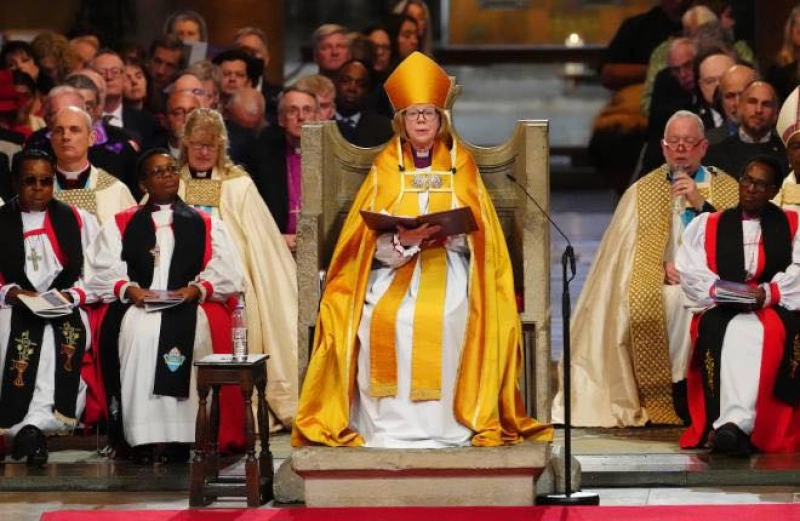
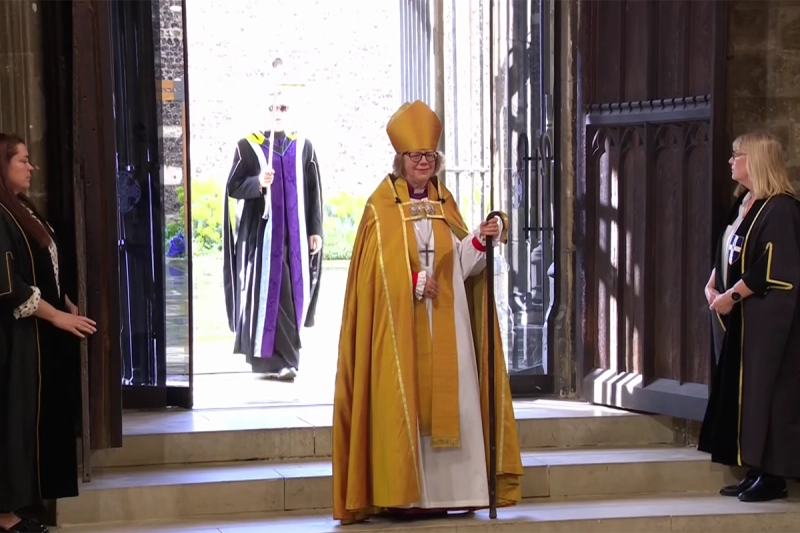
Archbishop of Canterbury Sarah Mullally was installed March 25 at a service at Canterbury Cathedral that was attended by leaders from across the Anglican Communion, including Presiding Bishop Sean Rowe and several other representatives from The Episcopal Church.
The ceremonial installation marks the start of Mullally’s public ministry. As the 106th archbishop of Canterbury and the first woman to hold that office, she acknowledged that history and her unlikely path to this moment in her sermon.
“I make this journey both on a personal level … but more significantly I make this journey with others and in the footsteps of the past,” she said, mentioning Thomas Becket, who served as archbishop of Canterbury 850 years ago. “Today, I think of the many thousand unknown Christians who have trodden these same paths since, and not just on this ancient land, but all across the world. People walk the pilgrim paths of faith each and every day.”
Mullally, 63, was ordained to the priesthood in 2001 after a career as a nurse treating cancer patients and had served as the bishop of London since 2018. As archbishop of Canterbury, she now leads the Church of England and serves as a “focus of unity” for all 42 autonomous, interdependent provinces of the Anglican Communion, including The Episcopal Church, which have historical roots in England.
She was named the church’s next archbishop of Canterbury in October, and she took office Jan. 28 after her election was confirmed. Her installation service, also known as an enthronement, at the 1,400-year-old Canterbury Cathedral was livestreamed on the Church of England’s YouTube channel.
The installation also marked the feast day of the Annunciation of Our Lord. The cathedral released the order of service here. During the procession of bishops before the service, more than 5,000 viewers already were watching online, and that number topped 8,000 after the service got underway.
“This is a truly global gathering,” Canterbury Cathedral Dean David Monteith said in welcoming remarks at the start of the service that acknowledged the geographic breadth of those in attendance. “We meet in the name of our Lord Jesus Christ, in whose service we are united.”
After a ceremonial reading of the mandate for Mullally’s installation, those inside the cathedral stood as, outside, the new archbishop gave the customary three knocks with her pastoral staff on the cathedral door, which opened for her entrance.
“I am Sarah, a servant of Jesus Christ, and I come as one seeking the grace of God, to travel with you in his service together,” Mullally said, in the words appointed for the liturgy. “I am sent as archbishop to serve you, to proclaim the love of Christ and with you to worship and love him with heart and soul, mind and strength.”
After processing to the nave altar, Mullally kneeled, and Monteith said: “Let us join Sarah, our archbishop, in prayer for God’s blessing on her ministry in this diocese, in the Province of Canterbury and throughout the worldwide Anglican Communion.”
Archbishop of York Stephen Cottrell and Monteith then led Mullally through the Declaration of Assent and the Oaths, which she spoke after placing her hand on a Bible.
After she was formally installed, Mullally said: “I solemnly commit myself before you to the service of the Church of England, the Anglican Communion and the whole Church of Christ throughout the world, that together we may proclaim the Gospel of Christ who reconciles us to God and breaks down the walls that divide us.”
On the dean’s cue, all stood in applause.
Twenty-six Anglican primates — archbishops and presiding bishops who lead the Anglican Communion’s provinces — were reported in attendance at Mullally’s installation, including the Most Rev. Alba Sally Sue Hernández García, who was just elected primate of the Anglican Church of Mexico on March 21. Speaking in Spanish, she read the Gospel reading for Mullally’s installation, Luke 1:26-38.
In her sermon, Mullally noted that some Anglican leaders were unable to attend the service because of the war in the Middle East between the United States, Israel and Iran. “We pray for them without ceasing, and for all those in worn-torn areas of the world, in Ukraine, in Sudan and Myanmar, that they would know God’s presence with them, just as we pray for peace to prevail,” she said.
Ecumenical guests included the leaders of the Coptic Orthodox Church, Assyrian Orthodox Church, a representative from the Vatican, other Roman Catholic officials and British Protestant leaders. Others present included representatives from a wide range of global faith traditions, including Judaism, Islam, Buddhism and Sikhism.
Mullally preached about the Gospel story of Mary’s acceptance of God’s call, saying it was an inspiration for her and for all Christians.
“As I look back over my life, at the teenage Sarah who put her faith in God and made a commitment to follow Jesus, I could never have imagined the future that lay ahead, and certainly not the ministry to which I am now called,” Mullally said. “Mary followed in the footsteps of the faithful. Her story resonates with the beautiful stories of women, like Hannah, in the Scriptures. Mary put her hope in God’s future. She trusted that he was with her, and through Mary, God did a new thing.”
As archbishop of Canterbury, Mullally is considered one of four “Instruments of Communion” that bring together the 42 provinces of the Anglican Communion across more than 165 countries. The other three Instruments of Communion are the Anglican Consultative Council, the Primates’ Meeting and the Lambeth Conference of Anglican bishops. Mullally is scheduled to convene her first meeting of the Anglican Consultative Council, or ACC, this summer in Belfast, Northern Ireland.
The archbishop of Canterbury’s global leadership role had been called into question under Mullally’s predecessor, former Archbishop of Canterbury Justin Welby, when in 2023 the Church of England began allowing same-sex couples to receive blessings in its churches. Some conservative bishops said they rejected the continuation of England’s centrality in the Anglican Communion, and they also have said their provinces are in “impaired” communion with provinces like The Episcopal Church that are more progressive on issues of LGBTQ+ inclusion.
Other Anglican leaders have heralded the choice of Mullally as the Church of England’s new leader, with hopes that she can guide the Anglican Communion through this time of rising tensions.
“I think she is an extraordinary leader,” Rowe said in an interview with Episcopal News Service in Canterbury before the installation. “She brings with her so many charisms of the spirit and experience in the world. I think she’s going to give us a new perspective on the Communion and being together. I think she’s going to provide leadership that’s entirely different than what we’ve seen to this point, and I, for one, am excited to be working with her.”
Other Episcopal leaders who attended included Indianapolis Bishop Jennifer Baskerville-Burrows, vice-chair of the House of Bishops, and House of Deputies President Julia Ayala Harris. Pennsylvania Bishop Daniel Gutiérrez was at the cathedral as president of the Anglican Communion’s Compass Rose Society.
“It’s a huge honor to be here to represent the House of Deputies of The Episcopal Church, especially because the archbishop of Canterbury is a woman,” Ayala Harris told ENS before the installation. “Her service today is a celebration of women’s leadership throughout the church, back to Mary, the mother of Jesus.”
Members of the British royal family also attended the installation, including Prince William and Princess Catherine. The Church of England is uniquely connected to the government of England, and King Charles III serves as the church’s supreme governor — a role that does not extend to any other Anglican province.
Before her installation, Mullally chose to travel to Canterbury by foot, leaving London on March 17 on a six-day walking pilgrimage across about 140 kilometres (or about 87 miles), accompanied by her husband, Eamonn, and others. They followed the Becket Camino route, from St. Paul’s Cathedral to Canterbury Cathedral.
“As a church, we are a pilgrim people, and like Mary, we are called to trust that nothing will be impossible with God, even when we see so much in the world that makes hope seem impossible,” Mullally said in her sermon. “But there is hope, because we make this journey with God.
“We do not bear the weight of this calling in our own strength, but only in the grace and power of God. We walk with God, trusting that God walks with us, trusting that in all that we face, in the sorrow and the challenges as much as in the joy and the delight, we do not walk alone. There is hope, because we are invited to trust that God will do a new thing.”