Online resource centre for Anglican-Roman Catholic relations
Read the full text below
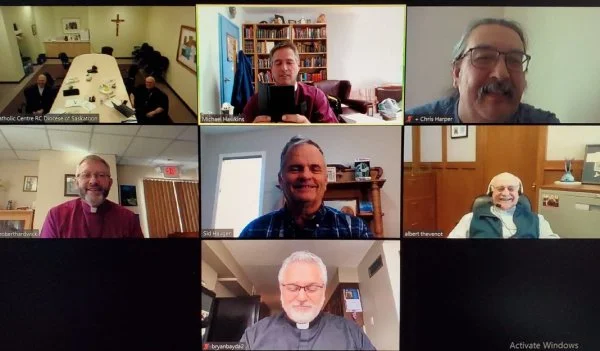
Building upon the 2011 covenant between the Archdiocese of Regina and the Diocese of Qu’Appelle, the Lutheran, Anglican, Ukrainian Catholic, and Roman Catholic churches across Saskatchewan entered into a covenant in 2020. Although it was several years in the drafting, the covenant was signed virtually during the COVID-19 pandemic lockdown.
We believe in a God whose life is communion and pure love, and that we ourselves share God’s life in Christ through the Holy Spirit. All that we do … and, in particular, all that we seek to do together, should therefore be done in communion, with grace and generosity so that we do not obstruct the proclamation of the Good News.[1]
In thanksgiving to God for closer relations between Catholics, Anglicans, and Lutherans over the past decades, our churches continue to pray for our growth towards the full visible unity of the Church of Christ for which our Lord prayed, “that all may be one” (Jn. 17:21). Our ecumenical relations are deep-rooted through more than a century of cultivation – at first tentative but now confident – in common witness, study, and service. May God continue to bless our endeavours with a rich harvest in our mission together.
Expanding our covenantal vision
Since 2011, the Anglican Diocese of Qu’Appelle and the Roman Catholic Archdiocese of Regina have shared a covenant which continues to call us to “a new stage in jointly building up the body of Christ in our dioceses.” Certainly, our covenantal relationship is not our only ecumenical or ecclesial relationship. Our partnerships in local ministerials, regional ecumenical projects, interchurch coalitions, councils of churches, and shared ministries have contributed to a rich ecumenical life across Saskatchewan. We are therefore enthused to incorporate the Anglican and Roman Catholic dioceses of central and northern Saskatchewan within the covenant.
The Anglican Church of Canada and the Evangelical Lutheran Church in Canada have been full communion partners since 2001. The union between the Ukrainian Catholic and the Roman Catholic churches occurred in 1595-96 and has enjoyed a renaissance in mutual sharing and learning since Vatican II and the end of the Soviet occupation of Ukraine. The 2011 Anglican-Roman Catholic covenant envisioned a time when the Lutheran and Ukrainian Catholic communities would join us in this renewed covenant. Now is the opportune time to broaden our covenantal promises and to invite our communion partners to share together in work for visible unity.
As we enter into this renewed covenant we must attend to the new facets of this relationship. Lutherans and Roman Catholics have been active ecumenical partners in Canada for 50 years, so we must ask how the covenant can enrich this relationship? Ukrainian Catholics have been ecumenically engaged throughout these years, but many of the concerns, perspectives, and gifts of the Eastern churches have not been the focus of ecumenical life in Canada. How might this covenant encourage the mutual enrichment of East and West, so that the church, in the words of Pope John Paul II, might “breathe with two lungs”?
The relationships within this renewed covenant are asymmetrical. The Anglican-Lutheran full communion and the communion of the Roman and Ukrainian Catholic churches are analogous, in the sense that each preserves the unique theological, liturgical, and spiritual traditions of each partner while allowing for an exchange of sacraments and ministry. This covenant is not intended to change the relationship between these communion pairs, although it is hoped that it might be an enrichment. Nor can the covenantal relationship extend the provisions of the communion partnership to the new partners. In particular, the covenant does not change the disciplines of our churches regarding sacramental life or recognition of ministry.
International and national dialogues between Catholics, Anglicans, and Lutherans have led to many agreed statements on important matters of theological dispute arising from five centuries of separation. Many 20th-century reforms of the churches and their liturgies have drawn us closer in faith and witness. Working together in social justice, care for the poor, chaplaincies, and other aspects of the church’s life and work has allowed us to grow together and increasingly to reveal the oneness of the body of Christ.
The framework of covenant: a real but incomplete communion
The fundamental unity of the church of Christ is expressed in our common baptism into the one body of Christ. We confess one Lord, one faith, one baptism (Eph. 4). Christ is not divided! (1 Cor. 1). However, the ecclesial communion that is real and true in Christ is incompletely realized in the life of the churches and therefore in their relationships during the course of history. Through the ecumenical movement we catch sight of that full, visible unity which is God’s will for the Church, and to which we are called as Christian communities. In this covenant, we seek to grow together in this real but incomplete communion.
Among the many ways that churches have found to express our growth in communion, covenants have a particular place. Beyond the most basic sense as a mutual agreement or contract, the biblical understanding of covenant is of a relationship initiated by God; a promise to which God remains faithful despite the failures and transgressions of the people. A covenant serves to sustain and nurture an established ecumenical partnership. It requires a fundamental commitment to working, praying, and acting together in response to God’s call, yet it is not the final stage of life in communion. We engage in this covenant as a pledge of faithfulness and in hope of the full visible unity to which we are called.
Ecumenical covenants are framed in such a way as to encourage our communities to grow in understanding and knowledge of one another. The asymmetry of this covenant reflects the degree to which our communities are already moving beyond basic ecumenical encounter into various forms of common life together. We invite our communities to find additional ways to engage together in prayer, study, action, social life, and ecumenical leadership.
The elements of covenantal life together
As churches together we commit to finding ways to celebrate and to effectively live out our real but incomplete communion.
Prayer together – Prayer is central to our communal experience as Christians. Our communities are formed in and around the worship of Jesus Christ, worship which expresses our hope and faith. As churches committed to the Gospel imperative of unity, we desire to worship together wherever possible. We commit our churches to seek further opportunities to share our common faith in Christ through prayer with one another.
Study together – Our faith is nourished by reflection upon Scripture, the theology and history of our faith communities, and the conditions of our own day. As Christian churches, we have for many decades undertaken this reflection together, and we have enjoyed the benefits of diverse experiences and views. We commit our churches to seek further opportunities for common reflection, consultation, and study.
Action together – Christian faith impels us to action. In Christ’s name, we proclaim liberty to captives and good news to the poor. We commit our churches to give visible witness and to join in common cause to further the Gospel. We encourage our parishes and congregations to share in ministry to the poor, evangelism, hospital and home visiting, and social advocacy.
Social life together – Christian community, nourished in prayer and Scripture, blossoms into a community of social concern and personal support. Building this community supports the living experience of unity. Gathering to celebrate our life together contributes to a greater sense of communion. Social media and other technology can maintain and strengthen connections between churches across the vast landscape of Saskatchewan. We encourage our congregations to invite neighbouring churches to participate in significant celebrations within the life of the community.
Ecumenical leadership – As churches committed to the visible unity of the one body of Christ, and enriched by many experiences of ecumenical encounter, the covenant partners are uniquely situated to be catalysts for new ecumenical ideas, projects, and relationships. As artisans of unity, we commit our churches, while remaining faithful to our respective traditions, to be laboratories of ecumenical experimentation towards deeper participation in the mystery of Christ. We will invite other Christian communities to share in local ecumenical projects and we will invite them to share our covenantal life.
Practical commitments to common mission
Our fundamental unity is in Christ but our churches remain divided on significant matters of theology and conscience. In our divided state we cannot do all things together, but there is much that we can do together. To that end, our relationship now moves us to commit our four churches to the following:
1. Hold a prayer service each year, ideally in the Pentecost season, alternating among our churches, with our bishops present. This would take the form of an annual service of reconciliation, with participants (planning, officiants, servers, lectors, choir, etc.) from each church.
2. Regularly remember one another’s churches and leaders, and our relations, in our intercessions at Sunday eucharists.
3. Join together on justice-related initiatives locally and/or sponsor a justice-related project together in the developing world.
4. Find ways in which we might work and pray together in times of great need or emergency, for the good of all people.
5. Together, hold meetings with First Nations and Métis elders and communities to promote reconciliation and healing as we strive to respond to the Truth and Reconciliation Commission’s 94 Calls to Action.
6. Maintain communication among us when any new development in one of our churches has implications or challenges for the others.
We also encourage every diocese, eparchy, or synod, parish, or congregation to consider the following possible ways of implementing this covenant. Other Christian churches and their ministers could also be invited to share in these proposed activities and initiatives.
1. Shared services, Bible study, and other activities in the Week of Prayer for Christian Unity.
2. Common services in Advent and Lent.
3. Visiting each other’s churches, particularly to share in Sunday worship, while respecting the different disciplines of our churches. This would provide opportunities for experiencing each other’s eucharistic life, thereby serving both to deepen our communion and our desire for full communion.
4. Joint non-eucharistic worship, including faith-sharing celebrations, pilgrimages, processions of witness (e.g. on Good Friday), and shared public liturgies on significant occasions.
5. Making a public profession of faith together, perhaps by renewing baptismal promises at Pentecost each year.
6. Create new traditions together.
7. Shared witness in the name of Christ to people in particular spiritual need, including those who have lapsed from regular attendance at worship.
8. Parish welcome and support for interchurch couples and families.
9. Clergy sharing in the pastoral care of interchurch families (including marriage preparation).
10. Encouraging the inclusion of witnesses from other churches at baptisms and confirmations, particularly in the case of candidates from interchurch families.
11. Bishops acting together whenever possible: for example, issuing joint statements on current public pastoral concerns.
12. Inviting ordained and lay observers to attend each other’s synodal and collegial gatherings and conferences.
13. Consulting one another as fully as possible when providing pastoral care to people who may have a continuing pastoral relationship with another church.
14. Clergy acting together whenever possible: for example, holding occasional study days; arranging a joint component in our programs for baptism, confirmation, and marriage preparation.
15. Youth leadership: possibility of a joint youth group forming or occasional jointly-organized events with our youth.
16. Occasional workshops on aspects of the liturgy which would allow us to learn liturgical best practices from each other (e.g. welcoming/greeting, music, lectors, servers, those preparing intercessory prayers).
17. Meetings of those with parallel ministries: pastors; deacons; lay leadership/lay ministry; musicians; healing ministry; bereavement; church councils/vestries/parish councils.
18. Exploration of common texts – for example, the study of Scripture, or study of our agreed statements, e.g. Growing Together in Unity and Mission or From Conflict to Communion.
19. Social occasions following joint liturgical events, to offer opportunities for fellowship.
20. Fostering friendly relations and regular communication between neighbouring Anglican, Lutheran, Roman Catholic, and Ukrainian Catholic parishes and their clergy; encouragement to enter into parish covenants and hold annual events together.
21. Justice issues – speaking out together on areas of common concern where we can act together: prison ministry; relations with First Nations communities; healing ministry, chaplaincies, nursing homes.
22. Preparation for mission: coming together to identify specific concerns in the community and to provide gracious outreach, joining together to bring relief and Christ’s healing.
23. Joint participation in evangelism, shared training of lay people for evangelism, and the development of new ways of gathering faith communities.
Carrying the Covenant Forward
Relations between churches are always at the service of a broader vision of the unity of all Christ’s disciples. Therefore, it is our hope that this expanded covenant will continue to widen into a covenantal relationship among all Christian communities.
Furthermore, we hold many common elements of faith with other Christian churches in this province, most fundamentally: a Trinitarian faith into which we are baptized and which we profess in the Apostles’ Creed; a common recognition of Jesus Christ as Lord and Saviour to whom we commit ourselves in discipleship; common sources of authority in the Old and New Testaments and in the witness of the early Church which shape our mission; and a common hope and prayer grounded in God’s presence and action in the world and the promise of God’s Kingdom. In light of the common elements identified above, we are therefore prepared to enter into conversation with other Christian churches about the prospect of entering into a broader multilateral covenantal relationship.
Conclusion
We give our thanks to God, Father, Son and Holy Spirit, for the gifts we have received and which we have come to recognize in each other, for the joy we have come to know in our life in Jesus Christ, and for the renewed and life-giving relationship which has come to us from the Holy Spirit. To God be the glory, in the Church and in Christ Jesus to all generations, forever and ever. Amen (Ephesians 3:21).
Signed:
Most Rev. Bryan Bayda
Ukrainian Catholic Eparchy of Saskatoon
Most Rev. Donald Bolen
Roman Catholic Archdiocese of Regina
Most Rev. Murray Chatlain
Roman Catholic Archdiocese of Keewatin-Le Pas
Most Rev. Mark Hagemoen
Roman Catholic Diocese of Saskatoon
Right Rev. Adam Halkett
Bishop of Missinippi
Anglican Diocese of Saskatchewan
Right Rev. Robert Hardwick
Anglican Diocese of Qu’Appelle
Right Rev. Christopher Harper
Anglican Diocese of Saskatoon
Rev. Sid Haugen
Evangelical Lutheran Church in Canada
Synod of Saskatchewan
Right Rev. Michael Hawkins
Anglican Diocese of Saskatchewan
Most Rev. Albert Thévenot, M. Afr.
Roman Catholic Diocese of Prince Albert
Notes
1. IARCCUM, Growing Together in Unity and Mission, para. 97. https://iarccum.org/doc/?d=32