Anglican-Roman Catholic Dialogue ~ IARCCUM.org
Online resource centre for Anglican-Roman Catholic relations
• 2026
• 2025
• 2024
• 2023
• 2022
• 2021
• 2020
• 2019
• 2018
• 2017
• 2016
• 2015
• 2014
• 2013
• 2012
• 2011
• 2010
• 2009
• 2008
• 2007
• 2006
• 2005
• 2004
• 2003
• 2002
• 2001
• 2000
• 1999
• 1998
• 1997
• 1996
• 1967
• 1966
 We invite you to visit our Bluesky feed, a new social media platform that replaces Twitter/X. Bluesky has reintroduced content moderation and eliminated advertizing. Follow us now on Bluesky.
Pope and Archbishop of Canterbury exchange letters on Archbishop Sarah’s Installation (26 Mar 2026)
Archbishop of Canterbury Sarah Mullally installed in service attended by Anglican Communion leaders (25 Mar 2026)
Belgian bishop plans to ordain married men to fulfil Synod vision (21 Mar 2026)
Gafcon to be led by new Global Anglican Council including clergy, laity, and bishops (6 Mar 2026)
IASCUFO shares learnings and supplement to The Nairobi-Cairo Proposals in preparation for ACC-19 (2 Mar 2026)
News & Opinion
• 2026
• 2025
• 2024
• 2023
• 2022
• 2021
• 2020
• 2019
• 2018
• 2017
• 2016
• 2015
• 2014
• 2013
• 2012
• 2011
• 2010
• 2009
• 2008
• 2007
• 2006
• 2005
• 2004
• 2003
• 2002
• 2001
• 2000
• 1999
• 1998
• 1997
• 1996
• 1967
• 1966
News & Opinion from the Anglican-Roman Catholic dialogues
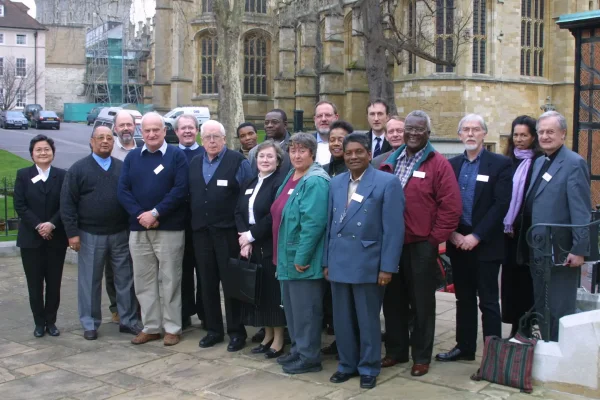
The Lambeth Commission today expressed its sadness over the “strident language” being used in the debate now besetting the Anglican Communion over the issues of openly gay clergy and same sex unions. In a statement following its first full plenary meeting under the chairmanship of the Most Revd Robin Eames, the Primate of all Ireland and Archbishop of Armagh, at St George’s House, Windsor, the commission sets out its work-plan for the next few months.
Due to report to the Most Revd Dr Rowan Williams, the Archbishop of Canterbury, in September 2004, the commission has organised small working groups to study and reflect on five key topics. The subject areas are:
Issues of process in the Anglican Communion; The nature and purposes of Communion; The obligations of Communion; Authority; The role of the instruments of unity in preserving fellowship
The Anglican-Roman Catholic International Commission (ARCIC) has agreed on a methodology based on Scripture and theological reflection in its attempt to fix a strategy to go behind what it describes as “entrenched positions” on the Virgin Mary.
The Commission has just concluded its week-long meeting in Seattle under the co-chairmanship of Australian Anglican Primate and Perth Archbishop Peter Carnley.
It completed work on the text of the Seattle Statement, Mary: Grace and Hope in Christ, which it is now submitting to the Pontifical Council for Promoting Christian Unity and to the Archbishop of Canterbury, together with the Anglican Consultative Council.
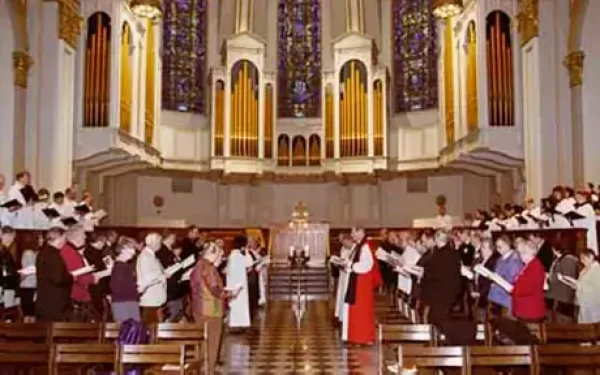
The Anglican-Roman Catholic International Commission (ARCIC) met from 28 January – 3 February at the Palisades Retreat Centre, Seattle, under the co-chairmanship of the Most Rev Alexander J Brunett, Archbishop of Seattle, and the Most Rev Peter Carnley, Archbishop of Perth and Primate of the Anglican Church of Australia.
The Commission completed work on the text of the Seattle Statement, “Mary: Grace and Hope in Christ”, which it is now submitting to the Pontifical Council for Promoting Christian Unity and to the Archbishop of Canterbury together with the Anglican Consultative Council.
The 160th anniversary of the publication of “True Devotion to Mary” has given John Paul II the chance to recall the doctrine of its author, St. Louis-Marie Grignion de Montfort. It is to the saint that the Pope owes his episcopal motto, “Totus Tuus,” an expression of his total belonging to Jesus through Mary. In his youth, Karol Wojtyla received “a great help” from the work.
“I found the answer to my perplexities due to the fear that the devotion to Mary, if excessive, might end by compromising the supremacy of the worship owed to Christ,” the Pope said in his message to the religious of the Montfort family, which the Vatican press office published today. “Under the wise guidance of St. Louis-Marie, I understood that, if one lives the mystery of Mary in Christ, such a risk does not exist,” the Pope said in his letter dated Dec. 8, solemnity of the Immaculate Conception.
The full Commission will meet as a whole on three occasions: in February; June; and September 2004. It intends to complete its initial report on the nature, extent and consequences of Impaired Communion in the Anglican Communion as a result of recent developments by the end of September 2004 for submission to the Archbishop of Canterbury in October. Intensive work will also be commissioned from individual members of the Commission and others, and undertaken beyond the main sessions set out above.
As required by its mandate, the Commission will begin by considering recent work elsewhere on the issue of Communion. It will give primary consideration to the resolutions of the Lambeth Conferences of 1988 and 1998 on this issue, together with a consideration of what has been achieved in the Grindrod, Eames and Virginia Reports, which addressed matters of Communion, particularly in relation then to the issue of the ordination of women to the episcopate. It will also wish to give especial attention to the recent work of the Inter Anglican Theological and Doctrinal Commission on the theological nature of Communion, and the various statements and pastoral letters issued by the Primates at their recent meetings.
There are no plans at this stage to hold sessions of the Commission in public, but it is felt that it will be important for the work of the Commission to be as open as possible. For this reason, evidence considered by the Commission will generally be published on the web site associated with the Commission, and it is intended to publish interim reports of the work of the Commission following each plenary session. Specific submissions to the Commission will be invited from particular groups or individuals, both in written form and by the reception of evidence in interview, either at plenary sessions, or at subsidiary meetings and sub-committees. The Initial Report in its final form will not be published until it has been received formally by the Archbishop of Canterbury.
The Most Revd Peter Carnley, Primate of Australia, has been asked to fill the post of co-chair of the Anglican-Roman Catholic International Commission (ARCIC) by the Archbishop of Canterbury, the Most Revd Rowan D Williams.
Archbishop Carney was a member of the “Eames Commission” on women in the episcopate and has served the Anglican Communion in varying tasks over the years.
He has served as a member of the International Anglican-Roman Catholic Commission for Unity and Mission (IARCCUM), since its inception, and took part in the Mississauga consultation of May 2000, which reflected on the work of ARCIC over the past three decades and issued the texts “Communion in Mission” and the “Action Plan”.
Since the consecration of Gene Robinson as bishop of New Hampshire on November 2, nine of the 38 worldwide Anglican provinces have declared themselves to be in “impaired” or “broken communion” with all or part of the Episcopal Church in the United States.
The latest to assert its disassociation is the Province of South East Asia, one of the Communion’s most conservative churches. The province includes Anglicans in Malaysia, Singapore, Thailand, Indonesia, Cambodia, Vietnam, Laos and Nepal.
In a statement, the province said that it did not recognise the ministry of Gene Robinson “as a Bishop in the Anglican Church. We are no longer in communion with the Presiding Bishop of ECUSA and all those Bishops and Dioceses who voted for the confirmation of Dr [sic] Gene Robinson’s election and those who joined in the consecration of the same…. If ECUSA refuses to repent, we will commit ourselves through our Primate to work with like-minded Primates for the realignment of the Anglican Communion.”
Dialogue between the Catholic Church and the Anglican Communion has received its first setback since the American Anglicans consecrated an actively gay bishop last month. The Vatican said on Tuesday it was suspending a meeting in the United States scheduled for February which had intended to work on a common statement of faith between Catholics and Anglicans. The meeting “would have to be put on hold” because of “ecclesiological concerns” raised by “recent developments within the Anglican Communion,” according to a statement by the Vatican’s Council for the Promotion of Christian Unity, whose president is Cardinal Walter Kasper.
Advent is for Christians a season of hope and anticipation that precedes Christmas. But this year it is a time of splintered hopes for Seattle’s Roman Catholic Archbishop Alex Brunett.
Brunett has made ecumenical dialogue the touchstone of his 45 years as a Catholic clergyman.
He once was host for Jewish rabbis at a service at the Shrine of the Little Flower in Royal Oak, Mich., a church that was base for the 1930s anti-Semitic “radio priest” Father Charles Coughlin.
On Tuesday, November 25, 2003, Cardinal Walter Kasper, President of the Pontifical Council for the Promotion of Christian Unity, met with the Reverend Canon John L. Peterson, Secretary General of the Anglican Consultative Council, at the offices of the Pontifical Council.
At the meeting the future of Anglican-Roman Catholic dialogue was discussed, especially in the light of recent developments within the life of the Anglican Communion.
As a result of the conversation, it was decided that the next plenary session of the International Anglican-Roman Catholic Commission for Unity and Mission (IARCCUM) and its work towards the publication and reception of a Common Statement of Faith would have to be put on hold in the light of ecclesiological concerns raised as a consequence of these events. At the same time, the Anglican Communion and the Catholic Church remain committed to continuing their dialogue, and agree that the work of the sub-committees of the Commission would proceed.
On Tuesday 25 November 2003, Cardinal Walter Kasper, President of the Pontifical Council for the Promotion of Christian Unity, met with the Reverend Canon John L. Peterson, Secretary General of the Anglican Consultative Council, at the offices of the Pontifical Council. At the meeting the future of Anglican Roman Catholic dialogue was discussed, especially in the light of recent developments within the life of the Anglican Communion.
The Archbishop of Canterbury, Dr Rowan Williams, has received the resignation of the presiding Bishop of the Episcopal Church (USA), Bishop Frank Griswold, as Anglican Co-chair of the Anglican-Roman Catholic International Commission. Following recent events in the life of ECUSA, Bishop Griswold has written to the Archbishop of Canterbury to announce his decision, in the interests of “not jeopardizing the present and future life and work of the Commission”. In his response, Archbishop Williams thanked Bishop Griswold for his “outstanding labour and commitment.” The text of the letters is below.
ARCIC began work in 1970, following the historic meeting of Archbishop Michael Ramsey and Pope Paul VI in Rome in 1966. It has produced agreed statements on many of the questions that have divided the Roman Catholic Church and the Anglican Communion, particularly in the areas of Eucharist, Ministry and Authority. Bishop Griswold has been the Anglican Co-chair since 1998. The Roman Catholic co-chair is Archbishop Alex Brunett, Archbishop of Seattle. A new Anglican co-chair will be appointed by the Archbishop of Canterbury, after consultation with the Secretary General of the Anglican Consultative Council.
Named today by the Archbishop of Canterbury to lead a 16-member commission formed to report on “understandings of communion” that unite Anglicans worldwide, Archbishop Robin Eames of Ireland said this morning that opportunities for growth and reconciliation can be found amid “what some are calling a crisis” in Anglicanism worldwide as the Episcopal Diocese of New Hampshire proceeds with the November 2 ordination of a bishop living in a same-sex union with his male partner.
“We will try under God to provide channels on communication, channels of understanding, but most of all a path forward,” Archbishop Eames said in remarks to a previously scheduled gathering here of the Compass Rose Society, an organization of supporters of the mission of the Anglican Communion. “Please pray for me,” he asked.
Archbishop Eames, who from 1988-93 led a similar international commission on the ordination of women who now serve as priests and bishops in many of the Anglican Communion’s 38 member churches, said he did not accept the invitation from Dr Williams “easily” but “there are times in life that … a situation has to be addressed.”
The Archbishop of Canterbury, Dr Rowan Williams, has announced the makeup and the terms of reference for a Commission to look at life in the Anglican Communion in the light of recent events. It is to be made up of members appointed by the Archbishop of Canterbury and will be chaired by the Most Revd Robin Eames, Archbishop of Armagh.
The Commission, which is expected to begin its work early in the New Year, was formed as a result of a request from the recent Primates meeting at Lambeth Palace to the Archbishop of Canterbury. It will take particular account of the decision to authorise a service for use in connection with same sex unions in the Diocese of New Westminster, Canada, and the expected Consecration of the Revd Canon V Gene Robinson as Bishop Co-adjutor of New Hampshire in the Episcopal Church (USA) on Sunday, November 2nd.
The broad smiles and warm handshakes told it all. Christians and Muslims are back on track discussing the “heavenly religions,” as the Sunni Muslim leader put it.
The Archbishop of Canterbury, Dr Rowan Williams, played a key role in re-establishing the dialogue that was disrupted in the wake of the election of Canon Gene Robinson – an openly gay man living in a committed relationship – as bishop of New Hampshire. A letter from him to the Grand Imam of Al-Azhar Al-Sharif, Sheikh Mohamed Sayed Tantawy, delivered October 4, reassured the Sunni leader that Anglicans were not about to change their theology.
The letter which was delivered by the Episcopal Bishop in Egypt, the Rt Revd Dr Mouneer H Anis, said that the official position of the Anglican Communion over human sexuality remains unchanged.
When Archbishop Geoffrey Fisher returned from his historic visit to Pope John XXIII in 1960 he reported that the Holy Father asked him when the Anglicans would come back to the Catholic Church. Fisher replied: ‘We cannot come back but we can go forward together.’ At the time this revelation stunned and excited both Anglicans and Catholics. It appeared to mark one the most hopeful moments in the 424 bitter years since Henry VIII broke with Rome and changed the ‘Church in England’ into ‘the Church of England’
On reflection the comment raises more questions than it answers about the one Church that existed before the schism, and about the Churches that might be going ‘forward together’. If there is no going back to the oneness of the Church before 1534, in what sense will the Churches be one in the new togetherness?
A glance at the early Church in Britain, and a more detailed look at some of the various manoeuvrings toward going ‘forward together’ can give us a somewhat better understanding of the difficulties involved.
In an effort to forge closer links with the Roman Catholic Church, the Most Revd Rowan Williams, Archbishop of Canterbury and president of the Anglican Communion, began a three-day visit to Rome yesterday, which will include a meeting with Pope John Paul II on October 4.
Archbishop Rowan is being accompanied by his wife, Mrs Jane Williams, and representatives of the Anglican Communion, including Canon James M Rosenthal and the Revd Canon Gregory Cameron. Also present as a member of the Archbishop’s official party is the Rt Revd Geoffrey Rowell, Bishop of the Diocese in Europe, who is responsible for overseeing the Anglican work in Rome.
The Blessed Virgin Mary has always had a special place in the hearts of Catholics of the Australian Church over its comparatively short history. The “mother church” of Australia, St Mary’s Cathedral in Sydney, first built in 1821, witnesses to the devotion of early Sydney Catholics, both clergy and laity, in being named in honor of the Blessed Virgin.
Our first bishop, John Bede Polding, had a particular devotion to the Virgin Mary, writing her initials atop all his writings. Two years after the establishment of the Australian hierarchy, Mary Help of Christians was proclaimed patroness of Australia. Devotion to the Blessed Virgin Mary, expressed in the 20th century particularly by a love of the rosary, is a strong element of Australian Catholicism.
In more recent times various devotional movements have brought about a renewed love of the Blessed Virgin Mary, following a dip in devotion in the latter quarter of the last century.
There are two references to Mary in “Nostra Aetate” [the 1965 declaration on the relation of the Church to Non-Christian religions].
The first notes that Muslims “also honor Mary, his virgin Mother; at times they even call on her with devotion” (NA, 3). The second emphasizes the Jewish roots of Jesus and his mother quoting Paul “about his kinsmen: ‘theirs is the sonship and the glory and the covenants and the law and the worship and the promises; theirs are the fathers and from them is the Christ according to the flesh’ (Romans 9:4-5), the Son of the Virgin Mary” (NA, 4).
Since Vatican II, the main areas of Mariological research in other religions have been in Judaism where the symbol “Daughter of Zion” has been studied and on the place of Mary in Islam (see “The Virgin Mary in Intellectual and Spiritual Formation,” [VMISF], Congregation for Catholic Education, March 25, 1988; No. 15).
In the beautiful final chapter of the dogmatic constitution of the Church “Lumen Gentium,” dedicated to the Virgin Mary, we read, “After this manner the Blessed Virgin advanced in her pilgrimage of faith, and faithfully persevered in her union with her Son unto the cross, where she stood, (see John 19:25) in keeping with the divine plan, grieving exceedingly with her only begotten Son, uniting herself with a maternal heart with his sacrifice, and lovingly consenting to the immolation of this Victim which she herself had brought forth. Finally, she was given by the same Christ Jesus dying on the cross as a mother to his disciple with these words: ‘Woman, behold thy son’ (see John 19:26-27)” (No. 58).