Anglican-Roman Catholic Dialogue ~ IARCCUM.org
Online resource centre for Anglican-Roman Catholic relations
• 2026
• 2025
• 2024
• 2023
• 2022
• 2021
• 2020
• 2019
• 2018
• 2017
• 2016
• 2015
• 2014
• 2013
• 2012
• 2011
• 2010
• 2009
• 2008
• 2007
• 2006
• 2005
• 2004
• 2003
• 2002
• 2001
• 2000
• 1999
• 1998
• 1997
• 1996
• 1967
• 1966
 We invite you to visit our Bluesky feed, a new social media platform that replaces Twitter/X. Bluesky has reintroduced content moderation and eliminated advertizing. Follow us now on Bluesky.
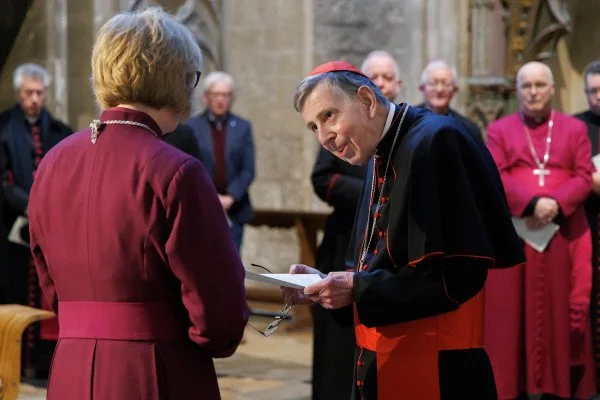
Pope and Archbishop of Canterbury exchange letters on Archbishop Sarah’s Installation (26 Mar 2026)
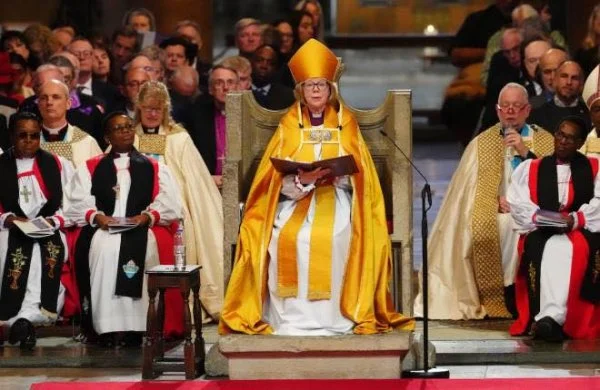
Archbishop of Canterbury Sarah Mullally installed in service attended by Anglican Communion leaders (25 Mar 2026)
Belgian bishop plans to ordain married men to fulfil Synod vision (21 Mar 2026)
Gafcon to be led by new Global Anglican Council including clergy, laity, and bishops (6 Mar 2026)
IASCUFO shares learnings and supplement to The Nairobi-Cairo Proposals in preparation for ACC-19 (2 Mar 2026)
News & Opinion
• 2026
• 2025
• 2024
• 2023
• 2022
• 2021
• 2020
• 2019
• 2018
• 2017
• 2016
• 2015
• 2014
• 2013
• 2012
• 2011
• 2010
• 2009
• 2008
• 2007
• 2006
• 2005
• 2004
• 2003
• 2002
• 2001
• 2000
• 1999
• 1998
• 1997
• 1996
• 1967
• 1966
News & Opinion from the Anglican-Roman Catholic dialogues
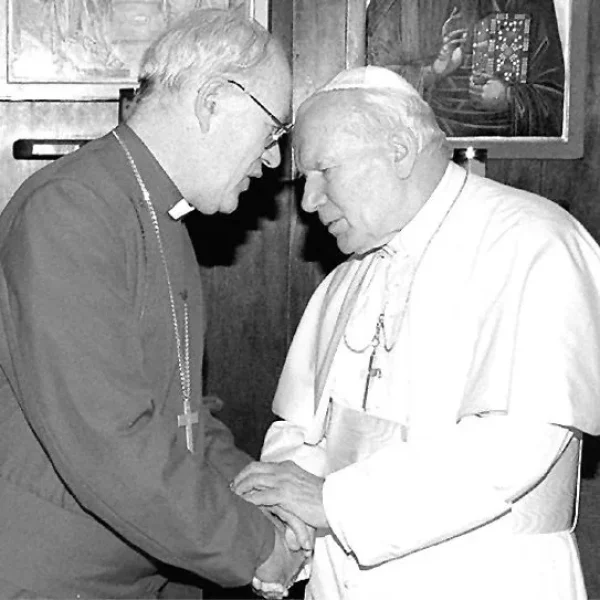
The Archbishop of Canterbury will pay his first official visit to His Holiness Pope John Paul II in Rome between 3rd – 5th December 1996. He will stay as a guest of the English and Welsh Catholic Hierarchy at the Venerable English College in Rome. During the course of his visit he will have private conversations with His Holiness and other Curial Officials, and he and the Pope will join together in the celebration of Vespers at the Church of San Gregorio al Celio.
Ecumenism is an inseparable part of the mission of the church to spread the Good News about Jesus Christ, a group of worldwide Anglican Church delegates was told recently. Bishop Mark Dyer of the United States said the necessity for ecumenism – ultimately the unity of all Christian churches – comes from Jesus’ words to his disciples the night before he was crucified, when he prayed that his followers might be one “in order that the world may believe.” Bishop Dyer told the 80-member Anglican Consultative Council meeting here that Christian unity is a sign to the world of the Kingdom of God. Consequently, he said, disunity is also a sign to the world, one that makes it hard for people to accept the gospel when churches can’t themselves agree on the essentials of the religion.
The end of the road is nowhere near being in sight yet, but solid progress is being made: this was the impression given by the communiqué and press conference that followed last week’s second meeting of the Anglican-Catholic joint preparatory commission, held at Huntercombe Manor, Taplow, Berks, from August 30th to September 3rd.
Indeed, the frequency of the commission’s meetings seems to be increasing: while the first meeting was held seven and a half months ago at Gazzada in northern Italy, it is hoped to hold the third meeting towards the end of December, at the most only four months hence. Where it will be held is not yet certain: it has to be some where near a large international airport, but the likelihood of fog at that time of year rules out London airport, and therefore England.
Following the week of talks at Gazzada last January, the Anglican/Roman Catholic joint preparatory commission for dialogue between the two Churches will hold its second meeting at Huntercombe Manor, Taplow, Berkshire, from August 30th to September 4th. In addition to all the delegates present at the Gazzada talks, the Catholic team will be strengthened by Bishop Butler, 0.S.B., auxiliary of Westminster, and Fr. Camillus Hay from Australia, while the Anglican team will also include Dr. H. R. McAdoo, Bishop of Ossory, Ferns, and Leighlin (Church of Ireland), and Dr. T. A. Mollegen (American Episcopalian), of the Protestant Episcopal Theological Seminary, Virginia. There will also be an observer from the World Council of Churches, Dr. Harding Meyer. The addition of a member of the Church of Ireland team would seem to be intended to answer the criticisms—voiced mainly by an Irish Jesuit writing in the Furrow — of the absence of any member of that Church from the Gazzada team.
Just before we went to press the first meeting of the Joint Preparatory Commission for dialogue between the Roman Catholic Church and the Anglican Communion was concluded at Gazzada, Varese, in the north of Italy.
The Joint Preparatory Commission met at the conference centre at the Villa Cagnola; Gazzada near Milan from 9-13 January 1967. Pope Paul VI and Archbishop Michael Ramsey, following their meeting in Rome on 23/24 March 1966, affirmed:
“Their desire that all those Christians who belong to these two Communions may be animated by these same sentiments of respect esteem and fraternal love, and in order to help these develop to the full, they intend to inaugurate between the Roman Catholic Church and the Anglican Communion a serious dialogue which, founded on the gospels and on the ancient common traditions, may lead to that unity in truth, for which Christ prayed”.
An Anglican-Catholic joint preparatory commission for dialogue between the two Churches has now been set up, in keeping with the common declaration made in Rome by Pope Paul and the Archbishop of Canterbury last March: in this the Pope and the Archbishop said they intended to inaugurate a serious dialogue covering not merely theological matters such as scripture, tradition and liturgy but also matters of practical difficulty felt on either side.