Online resource centre for Anglican-Roman Catholic relations
‘A Growing Sense of Urgency’: Lessons from ARCIC
31 July 2026 • Persistent link: iarccum.org/?p=5623
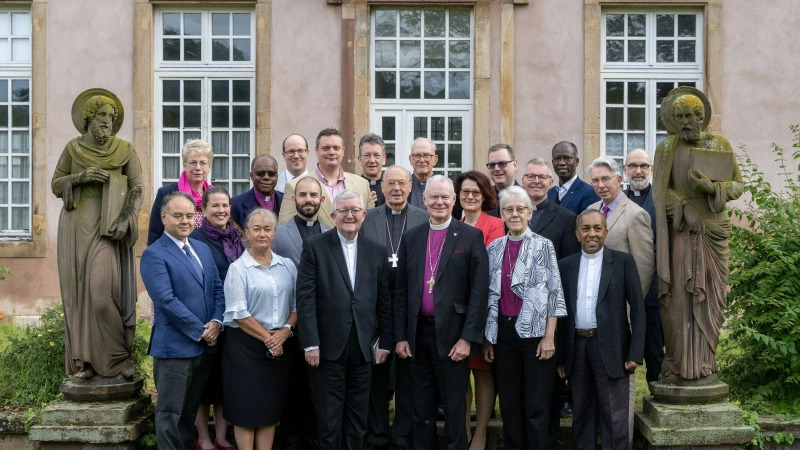
Given the trials and tribulations the Anglican Communion has endured the past few decades, it’s no surprise that the work of the Anglican-Roman Catholic International Commission (ARCIC) doesn’t frequently appear in the headlines. This is a shame, though, because ARCIC is one of the longest-standing Anglican ecumenical dialogues, and it continues to do important work. I’ve had the privilege of serving on the Commission for the past three years. I’ve learned a tremendous amount during that time, and it has profoundly shaped my understanding of ecumenism.
Most people know very little about ARCIC, if they know about it at all. Yet whether it’s parishioners I’m speaking with at coffee hour or academic theologians I’m catching up with at conferences, they all tend to ask the same set of questions: What issues are you trying to sort out now? What exactly happens at ARCIC meetings? Is the effort still worthwhile, given how far apart Anglicans and Catholics have become on issues like sexuality and women’s ordination? Do ARCIC members really think reunion is possible?
Read the rest of this article in The Living Church
ARCIC is completing its third phase, and the mandate for this phase was given by Pope Benedict XVI and Archbishop Rowan Williams: to consider “the Church as Communion—Local and Universal,” and to articulate how “in communion the Local and Universal Church comes to discern right ethical teaching.” The Commission’s forthcoming joint statement will be published (Deo volente) by the end of 2026, and will address the topic of moral discernment.
The purpose of the text isn’t to address current hot-button issues or to catalogue the specific moral teachings on which our churches disagree. Rather, the text is a work of fundamental moral theology. Yet, as I’ve learned during my time in the classroom as a professor of moral theology, it’s virtually impossible to say anything meaningful about fundamental moral theology without referring to concrete examples. Textbooks in moral theology evince this, as well. I challenge any reader to find an introductory moral theology text that introduces the Principle of Double Effect without illustrating it using the examples of self-defense or ectopic pregnancies.
The current ARCIC statement also recognizes this necessity. So, even while it remains tightly focused on the principles and process of moral discernment, it illustrates and develops these in light of case studies relating to slavery and contraception.
Why these two topics? In short, we can analyze them with the benefit of hindsight. They also reveal much about the ways in which our churches have exercised moral discernment. Several centuries ago, Anglican and Roman Catholic ecclesial authorities addressed the question of enslavement with a mixture of endorsement and ambivalence (a few voices expressed staunch opposition to the practice of enslavement, but these were rare). This stance developed over time, however, to the point where now both communions unequivocally condemn slavery as unjust and a gross violation of human dignity.
The case study on contraception, on the other hand, tells a different story. From the 16th century until the early 20th century, both churches condemned all forms of artificial contraception. During the 1930 Lambeth Conference, the Anglican bishops approved a resolution that cautiously endorsed contraception “in those cases where there is … a clearly felt moral obligation to limit or avoid parenthood, and where there is a morally sound reason for avoiding complete abstinence,” provided that the decision is made in light of Christian principles. Over the years, the endorsement of contraception became more expansive, and other Protestant denominations followed suit. Today, opposition to contraception is perceived as a uniquely “Catholic” position, and only rarely do Protestants (including Anglicans) discuss the morality of contraception.
What led these communions to walk in step on the question of enslavement yet diverge sharply on the question of contraception? This question is especially poignant, considering the fact that (as the current joint statement and its predecessor demonstrate) Anglicans and Roman Catholics broadly share the same moral theological framework. The current text grapples with this question, and along the way reveals insights that could only emerge from deep, sustained ecumenical engagements such as those occasioned by ARCIC.
Despite the obvious importance of questions like these, some may be dismissive of, or at least puzzled by, the work of ARCIC. Who seriously thinks this endeavor will result in Catholics and Anglicans being reunited? Doesn’t each communion have more important matters to attend to? Isn’t the Anglican Communion currently in turmoil? Something about deck chairs on the Titanic, etc.
One response to this sort of objection would be to abandon the hope of reunion altogether, justifying the work of ARCIC on other grounds. Some ecumenists do indeed take this approach. Ecumenism, after all, can have goals apart from reunification or conversion. The concept of “receptive ecumenism,” coined by the Catholic theologian (and ARCIC consultant) Paul Murray, reverses one of the questions traditionally assumed to motivate ecumenism (“What do other Christian traditions need to learn from us?”) by asking, “What does our church need to learn from others to heal its own weaknesses?”
The work of ARCIC III has largely been motivated by receptive ecumenism, and this approach has borne much fruit. But this doesn’t change the fact that the founding purpose of ARCIC, its raison d’être, was and remains the achievement of “full, organic unity of our two Communions.” These aims aren’t mutually exclusive. We can ask, “What do our churches need to learn from each other?” while still pursuing full, visible communion.
In 1968, the Malta Report of the Anglican-Roman Catholic Joint Preparatory Commission described the initial meetings of the Commission as “characterized not only by a spirit of charity and frankness, but also by a growing sense of urgency.” That sense of urgency and optimism pervading the first ARCIC texts, perhaps understandable in the 1960s and 1970s, has mostly faded. In many ways, the chasm between the Roman Catholic Church and the Anglican Communion seems deeper and wider than it did five decades ago.
So, what do I tell people when they ask me about my involvement with ARCIC? I can only speak for myself, of course. I’m only one member of the Commission. But frankly, I do feel a sense of urgency. I don’t mean that I expect our communions to be reconciled in my lifetime. If full, visible unity between Catholics and Anglicans is ever achieved, it will be according to God’s will and God’s timing. I seriously doubt that I (or my children or grandchildren, for that matter) will live to see it. It’s taken us nearly 500 years even to begin the process of reconciliation. It’ll be a miracle if it takes any less than that long to accomplish it.
I feel a sense of urgency in another sense. For one thing, it is indeed urgent that Catholics and Anglicans learn from each other. While we must each face our own failures and challenges, there’s something to be said for having a shared moral witness. It’s a great scandal to the unbelieving world that Christians often cannot agree on even the most basic moral teachings—or uphold the moral teachings they claim to believe. Catholics and Anglicans should be working together to prepare for the next moral crisis that lies over the horizon, whatever it may be.
I also feel a sense of urgency insofar as I long for the full, visible unity of the Church. Even if I have no reason to believe that this will occur in my lifetime, the fact that our Lord desires this unity (“Holy Father, protect them in your name that you have given me, so that they may be one, as we are one,” John 17:11) is what compelled me to serve on the Commission. Nothing makes that longing more tangible than the daily Eucharists during our annual ARCIC meetings. Anglican and Catholic clergy celebrate the Eucharist on alternating days, and everyone is invited. Yet, even while we pray, worship, discuss, argue, and laugh together, the reality of our sad divisions really hits home when we are unable to receive the Eucharist together.
That daily reminder of our separation is painful, but it’s what keeps us coming back. If God decides to use the work of ARCIC to reunite our communions, it won’t be because we finally solved a series of difficult theological puzzles. It will be because we kept coming back to the table until, by God’s grace, we could finally share the body of Christ together.